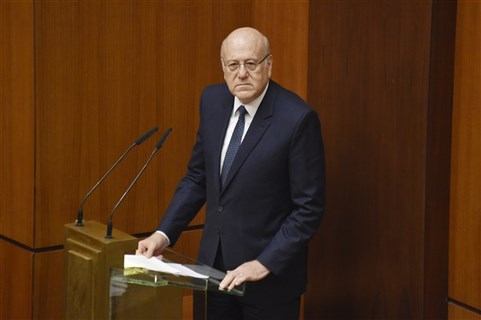
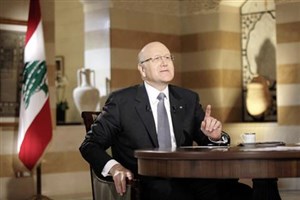
PM Mikati to quit if STL funding fails
Thursday, Nov 24, 2011
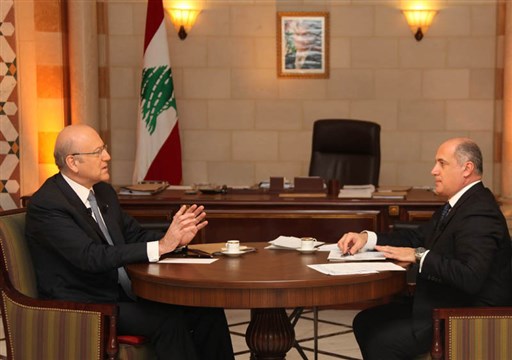
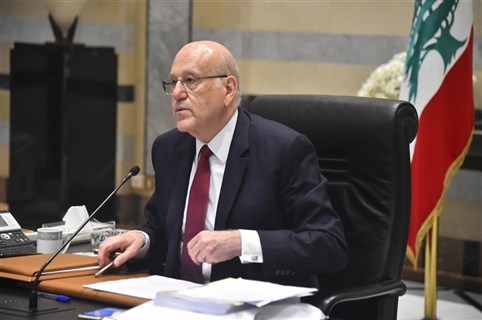
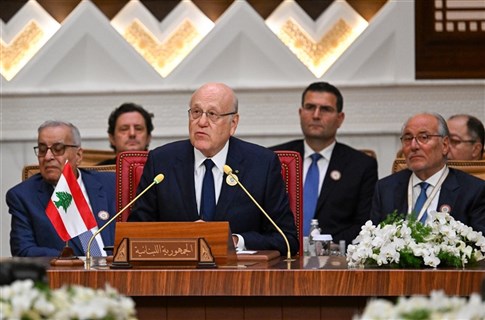
Prime Minister Najib Mikati said Thursday night he would resign if the Cabinet failed next week to approve the payment of Lebanon’s share to the funding of a U.N.-backed court, in a dramatic move that would plunge the divided country into further political turmoil.
Mikati warned that failure to fund the Special Tribunal for Lebanon would lead to the imposition of U.N. sanctions and the country’s isolation by the international community.
Asked what he would do if the Cabinet failed to approve paying Lebanon’s more than $30 million share to the STL’s annual budget, Mikati said in an interview with LBCI television: “The criterion is the Lebanese interest. I cannot imagine myself as prime minister with Lebanon under my mandate failing to honor its international obligations or is isolated by the international community. Simply, with the resignation I would be protecting Lebanon if the [STL’s] funding was not approved. My dream has been to protect Lebanon.”
“I think with my resignation, I will be protecting Lebanon if the Cabinet decided not to approve the funding. If I stayed in the government, sanctions will be imposed on Lebanon,” he said.
Mikati added that his resignation would be neutralizing Lebanon from possible sanctions.
“My concern is Lebanon. I cannot be a prime minister and expose Lebanon to any risk. My advice to all the ministers and [parliamentary] blocs is that they should take the funding [issue] seriously because it is related to Lebanon,” said Mikati, who appeared tense at times.
“I don’t want to expose the Resistance [Hezbollah] or Lebanon to danger. What matters is to send a signal that Lebanon is committed to international resolutions. This is very important,” Mikati said.
He urged those opposing the STL’s funding, mainly Hezbollah, the Amal Movement led by Speaker Nabih Berri and Michel Aoun’s Free Patriotic Movement to consider the funding of the tribunal as “an insurance policy against the storms in the region.”
Mikati said the divisive issue of the tribunal’s funding would be put up for a vote at a crucial Cabinet meeting scheduled on Nov. 30 after Finance Minister Mohammad Safadi sent a letter to the Cabinet demanding a loan from the treasury to pay Lebanon’s dues to the STL.
“This is a very important and very sensitive matter. Let everyone bear his responsibility,” he said.
As matters stand now, Mikati said there are 12 ministers who support the STL’s funding: six ministers for Mikati, three for President Michel Sleiman and three for Progressive Socialist Party leader Walid Jumblatt.
Mikati said he is betting on a change in the attitudes of some March 8 ministers to tilt voting in favor the STL’s funding. He added that he did not expect Hezbollah to change its tough stance on the tribunal’s funding.
“We are today 12 ministers [supporting the funding]. We can talk with three or four other ministers. What matters is Lebanon,” he said.
“If Lebanon decided to finance the tribunal, it would be fulfilling its obligations. We would be opening all the doors for cooperation with the West which could stop if we do not finance the tribunal,” Mikati said. “If I financed the tribunal, I would be committed to protecting the Resistance. If Lebanon is strong, the Resistance will be strong,” he added.
Asked to comment on repeated calls by the opposition March 14 parties for him to resign, Mikati said: “I will resign when Lebanon’s interest requires this.”
He said that since he was named prime minister in January to replace former Prime Minister Saad Hariri’s Cabinet which was toppled by the Hezbollah-led March 8 alliance, he has prevented Sunni-Shiite strife.
He defended his government’s policy to dissociate Lebanon from Arab or U.N. resolutions condemning Syria over its brutal crackdown on pro-democracy protesters. Mikati’s interview came a day after the new STL president, Sir David Baragwanath, held talks with him, Sleiman and Foreign Minister Adnan Mansour on cooperation between Lebanon and the tribunal.